
Every child develops at their own pace, and it can sometimes be hard to know whether your child’s communication patterns are simply part of their unique timeline or a sign that they could use some extra support. As a parent, you know your child better than anyone, and if something feels off about the way they’re communicating, trusting that instinct is worth taking seriously.
Speech therapy can make a remarkable difference when started early. The question most parents wrestle with is: when is the right time to reach out? This post walks you through the key warning signs by age, what a speech-language pathologist actually does, and how to take the next step if you think your child might benefit from support.
Understanding What Speech Therapy Covers
Many people assume speech therapy is only about pronunciation or stuttering, but it actually covers a much broader range of communication skills. A pediatric speech-language pathologist (SLP) works with children on:
- Expressive language: the ability to use words, sentences, and ideas to communicate
- Receptive language: the ability to understand what others are saying
- Articulation: clarity and accuracy of speech sounds
- Fluency: the rhythm and flow of speech, including stuttering
- Social communication: knowing how to use language appropriately in conversation
- Feeding and swallowing: oral motor skills that affect eating
- Augmentative and alternative communication (AAC): tools that help non-verbal children communicate
At Strides Pediatric Therapy, our pediatric speech therapy services address all of these areas with individualized, play-based approaches that keep children engaged and motivated.
Developmental Milestones to Watch
Speech and language development follows a general pattern, though there is natural variation among children. Knowing the milestones can help you spot when a child may be lagging in a meaningful way.
Birth to 12 Months
- Coos, babbles, and makes varied sounds
- Responds to familiar voices and sounds
- Uses gestures like waving or pointing by 9-12 months
- Says one or two words like “mama” or “dada” by 12 months
12 to 24 Months
- Has a vocabulary of at least 50 words by 24 months
- Begins combining two words (“more milk,” “daddy go”)
- Points to objects when named
- Follows simple two-step instructions
2 to 3 Years
- Uses 200 or more words
- Strangers can understand about half of what they say by age 2, and most of it by age 3
- Asks simple questions
- Begins using basic sentence structure
3 to 5 Years
- Uses 4-6 word sentences by age 4
- Can tell simple stories
- Understands most of what is said to them
- Almost all speech is understood by strangers by age 5
Signs Your Child May Benefit from Speech Therapy
While milestones are a helpful guide, you do not need to wait until your child is significantly behind to seek an evaluation. Here are some specific signs to watch for:
In Infants and Toddlers
- Not babbling by 12 months
- Not using gestures by 12 months
- No single words by 16 months
- Not combining two words by 24 months
- Losing previously learned language skills at any age
In Preschoolers
- Difficulty being understood by people outside the immediate family
- Frequent frustration when trying to communicate
- Difficulty following directions
- Limited vocabulary compared to peers
In School-Age Children
- Trouble with reading, writing, or spelling
- Difficulty understanding or following conversations
- Social struggles related to communication
- Persistent issues with certain sounds (like “r” or “s”) past age 7-8
It is also worth noting that speech difficulties can sometimes overlap with sensory processing challenges. In those cases, our pediatric occupational therapy team may work alongside the SLP to address the full picture.
Common Conditions That Benefit from Speech Therapy
Speech therapy is beneficial for a wide range of diagnoses and developmental profiles, including:
- Autism spectrum disorder (ASD)
- Apraxia of speech
- Cerebral palsy
- Down syndrome
- Hearing loss
- Cleft palate
- Selective mutism
- Traumatic brain injury
- Language delay without a diagnosed cause
Children do not need a formal diagnosis to receive speech therapy. If there is a concern about communication, that is enough reason to pursue an evaluation.
What to Expect During a Speech Therapy Evaluation
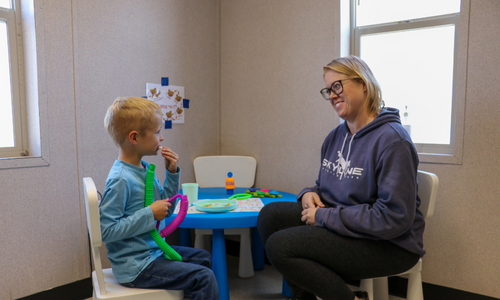
An initial evaluation with an SLP is typically a conversational and play-based process. The therapist will observe how your child communicates, engage them in structured activities, and gather information from you about your child’s developmental history.
From there, the SLP will discuss their findings with you and, if therapy is recommended, develop a treatment plan tailored to your child’s specific goals.
The Importance of Early Intervention
Research consistently shows that the earlier speech and language concerns are addressed, the better the outcomes. The brain is most adaptable in the early years, and children who receive support during this window often make significant gains in a shorter period of time.
Early intervention does not mean waiting for a problem to become serious. It means acting on a concern before it has a chance to affect other areas of development, including social skills, academic performance, and emotional well-being. Our speech therapy team at Strides is here to walk alongside you from the very beginning.
How to Get Started
If you have concerns about your child’s speech or language development, the best first step is to request an evaluation. At Strides Pediatric Therapy, we serve children from birth through age 21 and offer services across a full continuum of care, all at one location. Contact us to schedule an evaluation and learn more about how our team can help your child find their voice.